What Is a Tier List? Meaning, History, and 50 Ideas to Try
Tier list meaning, the origin of S tier, and 50 ideas to rank — from anime to fast food. Built around the free tier list maker.
A tier list is a ranking system that sorts items into labelled groups — S, A, B, C, D — from best to worst. Unlike a numbered ranking, a tier list lets multiple items share the same rank, which makes it perfect for comparing games, characters, food, or anything else where the order isn't strictly linear.
Tier List Meaning — What Does "Tier List" Mean?
A tier list is a ranking system that places items into labelled groups (tiers) ordered from best to worst. The standard labels are S, A, B, C, D — where S stands for "Super" or "Special" and represents the highest tier. Unlike a numbered ranking (1st, 2nd, 3rd), a tier list lets multiple items share the same rank, which makes it perfect for comparing things that don't have to be linearly ordered. That's the simplest tier list definition: labelled groups, items inside, S on top.
The History of Tier Lists
Tier lists started in the early-1990s fighting game community. Players on text-based gaming forums needed a quick way to discuss Street Fighter II character matchups, and grouping characters into tiers became the standard shorthand. The format was popularized on GameFAQs and Smashboards in the 2000s, then jumped from competitive gaming into anime, sports, food, and pop culture in the 2010s. Today, tier lists are a mainstream internet format used on Reddit, TikTok, YouTube, and Twitch every day.
Tier List Ranks Explained: S, A, B, C, D
The ranks run from S at the top down to D. A is great but not elite, B is good and reliable, C is average, and D is below average. Plenty of lists add an F row for the picks nobody should touch, and a few stack SS or SSS above S for real outliers. Why the top letter is S rather than A+ most likely goes back to Japanese grading, where an S grade sits above A. Our S tier meaning guide covers that story and how S differs from A.
What Is a Tier, and How Many Tiers Should a Tier List Have?
A tier is one row of a tier list: a level that groups items you rate about the same, and most tier lists use five tiers labelled S, A, B, C and D. The word itself is older than the format. Merriam-Webster defines a tier as one of two or more rows, levels or ranks arranged one above another, which is exactly how the board reads from top to bottom.
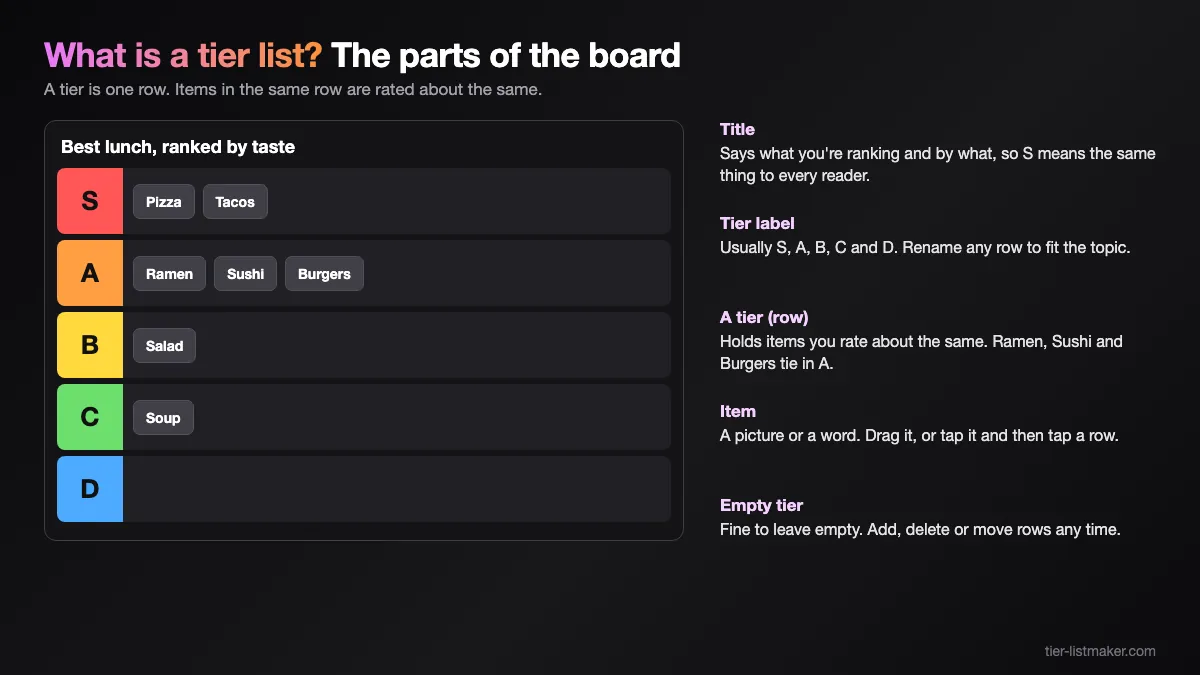
Five rows is a convention, not a rule. A short list of eight snacks can feel crowded with five tiers, because each row ends up holding one or two items, while a board of 60 game characters can need a sixth row so the middle doesn't become a dumping ground. A workable rule of thumb is roughly one row for every four to ten items, then adjust once you see the board filled in.
Our tier list maker opens with the five standard rows. You can add a row, rename any row to something that fits the topic, and move rows up or down, so a six-row S to F board or a three-row "Love it / Fine / Skip" board takes a few seconds to set up. For what each letter usually means, see the guide to what the tier letters mean.
How Is a Tier List Different From a Top 10 or an Iceberg Chart?
A tier list groups items into ranked rows and lets several items share a row, while a top 10 puts every item in a strict order and an iceberg chart sorts items by how well known they are rather than how good they are. Picking the right format saves arguments, because each one answers a different question.
| Format | How items are ordered | Ties allowed? | Best for |
|---|---|---|---|
| Tier list | Grouped into rows from best to worst | Yes, within a row | Opinions, game rosters, anything with many close calls |
| Top 10 list | One strict order from first to last | No | A short, definitive ranking |
| Iceberg chart | From well known at the tip to obscure deep below the water line | Yes, within a layer | Deep dives into a fandom's trivia and lore |
Iceberg charts are the newest of the three. The Wikipedia article on the tier list describes them as a popular variant that ranks items from most commonly known to most obscure, and dates their rise to around 2020. You can build one on the same board: rename the rows to "Everyone knows", "Fans know", "Deep cut" and "Only the wiki knows", then drag items down by how obscure they are.
Which Games Use Tier Lists the Most?
Tier lists are most common in competitive games with large casts of characters, where players rank who is strongest in tournaments: fighting games, MOBAs, hero shooters and character-collecting RPGs. Wikipedia names the Tekken and Super Smash Bros. series, League of Legends and Dota, Overwatch and Apex Legends, and Genshin Impact as examples, and major gaming sites publish their own tier lists for popular games.
Ready-made boards for several of those are on this site: the Tekken 8 roster, the Smash Ultimate fighters, the League of Legends champions, the Overwatch heroes and the Genshin Impact characters. Each opens the same maker with the whole cast already loaded, so a competitive ranking starts with dragging rather than typing.
What Can You Make a Tier List About? — 50 Tier List Ideas
Tier lists work for anything you can compare. Here are 50 starting points across five categories:
Gaming (10): video game characters, Pokémon starters, Genshin Impact units, Brawl Stars brawlers, Smash Bros fighters, Marvel Rivals heroes, Call of Duty weapons, Minecraft mobs, game soundtracks, retro consoles.
Anime (10): anime series, anime openings, anime studios, anime villains, anime endings, shonen protagonists, seasonal anime, manga series, One Piece arcs, Naruto characters.
Movies & TV (10): MCU films, horror movies, animated Disney films, Netflix originals, HBO series, sci-fi films, comedy shows, Pixar films, TV show seasons, movie directors.
Music (10): Taylor Swift albums, K-pop groups, rap albums by decade, music festivals, rock bands, music streaming platforms, music videos, Grammy winners, band eras, one-hit wonders.
Food & Life (10): fast food chains, pizza toppings, world cuisines, energy drinks, coffee shops, snack brands, streaming platforms, airlines, phone brands, programming languages.
How to Make Your Own Tier List in 60 Seconds
Pick a topic, open the image tier list maker for visuals or the text tier list maker for words, drag your items into S/A/B/C/D, and click Download. For the full walk-through with tips, read our step-by-step guide on how to make a tier list. No login, no watermark, ready to share in under a minute.
Frequently Asked Questions
What does 'tier list' mean?
A tier list is a ranking that groups items into labelled tiers (S/A/B/C/D) from best to worst.
What does S tier mean?
S tier means the highest rank — 'Super' or 'Special'. It's reserved for items considered the best of the best.
Who invented tier lists?
Tier lists originated in the 1990s fighting game community, where players ranked characters by competitive strength.
What's the difference between S tier and A tier?
S tier is elite — the best of the best. A tier is excellent but not quite top-level.
Are tier lists just opinions?
Yes and no. Competitive tier lists (gaming, sports) use objective data like win rates and stats. Personal tier lists are pure preference.
What are the tiers in a tier list?
The standard tiers in a tier list are S, A, B, C, and D — from best (S) to worst (D), with an optional F below D for truly bad picks and sometimes SS or SSS above S for outliers.
How many tiers should a tier list have?
Most tier lists use five tiers, S, A, B, C and D, and that is how our tier list maker opens. Five works well for roughly 20 to 50 items. Use fewer rows for a short list so each tier holds more than one item, and add a sixth row, usually F, for big rosters. You can add, rename and reorder rows at any time.
What is an iceberg chart?
An iceberg chart is a variant of the tier list that sorts items by how well known they are instead of how good they are. Famous items sit at the visible tip and obscure ones go deeper below the water line. The format became popular around 2020, and you can build one by renaming the rows of a tier list.
Related Templates
Anime Series Tier List — Rank Every Show From S to D Tier
Rank 20 of the most-debated anime series using this free tier list maker. From long-running shonen giants like One Piece and Naruto to modern masterpieces like Chainsaw Man and Jujutsu Kaisen, drag each series into the tier where you think it belongs. Add your own favourites, rename the tiers, change the colors, and export your finished anime tier list as a clean PNG to share on Reddit, Discord, or Twitter. No sign-up, no watermark — just your honest anime rankings. Also works as an anime character tier list if you swap in character names instead, or as a seasonal anime ranking for any year or cour.
Pokémon Starter Tier List — Which Starter Is the Best of All Time?
Every Pokémon generation has one question that divides the fandom forever: which starter is the best? This Pokémon tier list comes pre-loaded with every starter spanning generations 1 through 9. Drag Charmander, Froakie, Rowlet, and the rest into the tier they deserve — based on your childhood loyalty, competitive viability, or pure design taste. Add starters from Scarlet & Violet or any game, and export a crisp PNG to settle the debate on r/pokemon, Discord, or YouTube. No account needed.
Fast Food Chains Tier List — Which Chain Belongs in S Tier?
20 of the biggest fast food and fast casual chains pre-loaded. Drag McDonald's, Chick-fil-A, In-N-Out, and the rest into S, A, B, C, or D tier based on food quality, value, speed, variety, or your personal loyalty. Add regional chains not on the list — Whataburger fans, this is your moment — and export a PNG to start the debate on Reddit, TikTok, or Instagram. No account needed.